
Whether you’re already specifying adult changing stations or just hearing the term for the first time, a new standard of accessibility is here. Our continuing education course ensures you have the technical expertise to get it right — the first time.
The Dignity in Design CE course through Architectural Record defines these units and explains how adult changing stations enhance inclusivity and accessibility for people with physical or mobility disabilities in public buildings.
Successfully pass the online course, and you will earn the following credits:
- Architects: 1.0 AIA LU/HSW
- Designers: 1.0 IDCEC CEU/HSW
- Code Officials: 0.1 ICC CEU
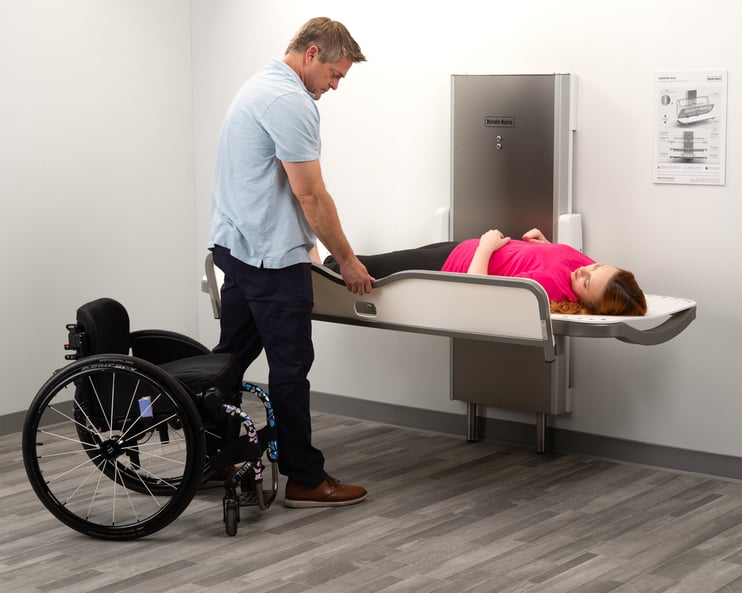
A caregiver assists an adult on a Koala Kare KB3000-AHL height-adjustable adult changing station. Learn about these stations and how to specify them with the Dignity in Design CE course.
What is an adult changing station?
An adult changing station is a height-adjustable table designed for individuals who cannot use a standard or ADA-compliant restroom for their personal care needs. While often found in a single-user or family-assisted public restroom, the table itself is the critical component that:
- Supports all ages from 2 through adulthood
- Provides a heavy-duty capacity, typically rated to at least 440 lbs
By adding these units to a dedicated universal or family-assisted restroom, those who use them maintain their privacy and dignity while changing clothes, managing catheters, or replacing incontinence pads.
Even if you feel you know the ADA requirements for bathrooms backward and forward, this new CE course is designed to ensure you’ll be ready to specify the main components of an adult-size changing station and understand the inclusive features of an individual restroom equipped with such a station.
Once you are ready to specify a station, Koala Kare Products offers two units:
- KB3000-AHL Adult Changing Station for high-traffic public spaces such as airports and stadiums
- KB2600 Adult Changing Station, a contemporary model often specified for controlled environments such as small schools, medical offices and houses of worship.
What are the design considerations when adding an adult changing station?
These spaces typically require a larger footprint than a standard ADA restroom to account for the table’s bed in the down position, plus the required clear floor space for a wheelchair. Also, height-adjustable units require structural blocking in the wall to support the user and a dedicated electrical circuit, usually 120V.
While the Dignity in Design course dives deep into the specific dimensions, there are three critical areas you should consider:
- Structural support: Does your wall assembly have the reinforced blocking required for a rated capacity of 440 lbs.?
- Power requirements: Have you coordinated with your electrical engineer for the dedicated circuit needed for height-adjustable units?
- Clearance envelopes: Have you accounted for the fold-down footprint and the wheelchair maneuverability space?
The full course covers how to analyze design considerations for these dedicated restrooms, including space, layout, structural, and other compliance criteria.
Are adult changing stations required?
From legislative mandates to changing code requirements, architects and designers should be aware of this solution that brings accessibility to people with disabilities, specifically those who are nonambulatory or have self-care challenges. Although the Americans with Disabilities Act does not yet require adult changing stations, building codes and other legislation now address this need.
The International Building Code includes a requirement that adult changing stations be provided in assembly and mercantile spaces with family or assisted-use toilets, college facilities, assembly spaces, and highway rest stops/service plazas, and that these stations meet defined accessibility and location criteria. Review the ICC A117.1 (Accessible and Usable Buildings and Facilities) to see the technical standards for how adult changing stations are built and check the code in your locale before starting a new project.
The Federal Aviation Administration Reauthorization Act of 2024 requires enhanced accessibility accommodations at medium and large U.S. airports, including provisions that drive the installation of adult changing stations in passenger terminal facilities by 2030.
Nine states have enacted legislation requiring these stations, and multiple other states have pending or proposed legislation. Whether you are designing for projects in California, Illinois, or Ohio staying ahead of state-specific adult changing station mandates is critical. See more details with our legislative map.
Who benefits from adding an adult changing station?
When the scope of disabilities is fully understood, the need for dedicated, inclusive restroom accommodation becomes profound. These dedicated, private restroom facilities are ideal for anyone with:
- Mobility disabilities
- Cerebral palsy
- Multiple sclerosis
- Muscular dystrophy
- Spina bifida
- Severe anxiety
- Autism
- Advanced dementia
- Inflammatory bowel diseases
- Crohn’s disease
- Epilepsy or conditions causing seizures
Without these stations, caregivers are often forced to change adults on restroom floors — an immense hygiene and safety risk for both the user and the caregiver. Alleviating that concern for caregivers is part of the reason this course credit is Health, Safety, and Welfare–approved.
Plus, the impact is material: 1 out of 4 Americans with mobility disabilities will leave a business and never return if they encounter an accessibility barrier.
What are my next steps?
Head to Architectural Record to find the Dignity in Design CE course.
Once you’ve completed the course, reach out to a Koala Kare Products representative for answers to any questions you may have about the product, specification, maintenance, installation, and more. Or visit koalabear.com.